The Creator Burnout Nobody Talks About (And How I Recovered)
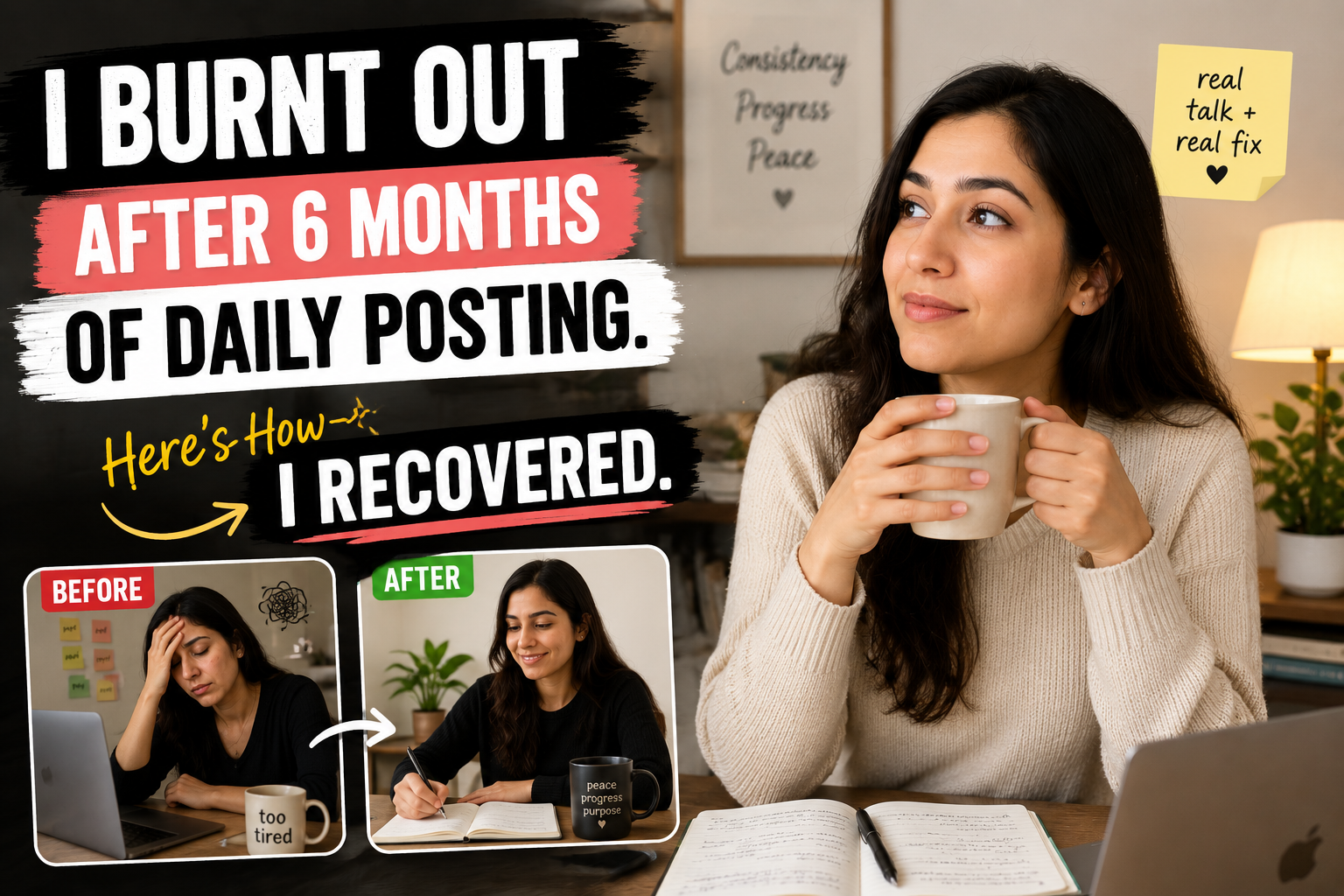
In January 2025, I stopped posting for two weeks because I could not look at my phone without feeling nauseous. Not metaphorically nauseous. Physically. My hands would shake when I opened Instagram. My chest would tighten when I saw a notification. I told my audience I was taking a "content break," which made it sound intentional and peaceful. It was not. I had crashed.
This article is about what creator burnout actually feels like, what caused mine, and how I rebuilt a content system that does not require me to sacrifice my mental health. I am writing this because every creator burnout article I have read describes burnout as being "tired" or "uninspired." My burnout was darker than that, and I suspect I am not the only one.
What Burnout Actually Felt Like
Burnout did not announce itself. It crept in over three months. The first sign was irritability. I snapped at a commenter who asked a genuinely innocent question. I deleted the reply immediately, but the shame stayed. The second sign was creative paralysis. I would sit down to write a caption and stare at the screen for 40 minutes, unable to form a sentence. The third sign was physical. I started getting tension headaches every evening, right around the time I usually posted. I blamed my desk setup. It was not my desk.
The breaking point came on a Tuesday. I filmed a Reel, edited it, wrote the caption, and scheduled it. Then I sat on my bathroom floor and cried for 20 minutes. I had no idea why I was crying. The post was fine. The metrics were fine. Everything was fine on paper. But I was not fine.
The Warning Signs I Ignored for 3 Months
I ignored every warning sign because I told myself I was being weak. Other creators posted daily. Other creators managed multiple accounts. Other creators did brand deals and consulting and product launches simultaneously. If they could do it, I should be able to do it.
That comparison was poison. I was comparing my behind-the-scenes to everyone else's highlight reel. I did not see the other creators taking breaks, outsourcing, or burning out in private.
The warning signs I specifically ignored:
- Checking my follower count first thing in the morning, every morning.
- Feeling genuine anxiety when a post underperformed.
- Skipping meals to finish editing.
- Canceling plans with friends because I "needed" to batch content.
- Dreaming about content ideas and waking up exhausted.
Every single one of those was a red flag. I saw them. I rationalized them.
What Triggered My Full Crash
The immediate trigger was a failed product launch. I spent six weeks building a $47 digital product. I announced it with a story sequence, a feed post, and an email. I sold 9 copies. Nine. The revenue was $423. The hours I spent were roughly 60. That is $7 per hour.
I had tied my self-worth to the launch. I told myself that if the product succeeded, I was a real creator. If it failed, I was a fraud. When it failed, the fraud story felt true. I did not have the emotional reserves to handle that story. I crashed.
The 2 Weeks I Completely Stopped Posting
I told my audience I was taking a "planned content break to focus on strategy." That was a lie. I was in bed. I deleted Instagram from my phone. I did not open my laptop for 8 days. I ate whatever was in the fridge. I watched reality TV for 6 hours a day. I felt guilty about all of it.
During the second week, I started feeling restless. Not the productive kind of restless. The anxious kind. I worried that my audience was forgetting me. I worried that the algorithm was punishing me. I worried that my income would collapse. I reinstalled Instagram, scrolled for 10 minutes, and felt sick again. I deleted it.
I started recovering when I accepted that my audience and my income were not my responsibility for those two weeks. My only responsibility was to recover.
How I Restructured My Content System to Be Sustainable
After the break, I rebuilt my workflow from scratch with one rule: no single point of failure. Nothing in my system should depend on my daily energy level.
I batch content in 3-hour blocks instead of daily creation. I film and design on Sundays. I do not touch content creation on weekdays.
I hired a part-time editor. I pay $200 per month for someone to do rough cuts and captions on my Reels. That saves me 5 hours per week.
I stopped posting daily. I post 4 times per week now. My growth slowed slightly, but my mental health stabilized completely.
I removed Instagram from my phone during work hours. I check it twice per day: 9 AM and 8 PM. No exceptions.
I track metrics weekly, not daily. Daily metric checking was my addiction. Weekly tracking gives me data without the dopamine rollercoaster.
The Mindset Shift That Changed Everything
The biggest shift was separating my identity from my metrics. I am not my follower count. I am not my engagement rate. I am not my monthly revenue. Those are outputs of a business. They are not measures of my worth.
I started repeating this to myself every morning: "The algorithm does not love me or hate me. It is math. My worth is not a variable in that equation." It sounds cheesy. It works.
Practical Burnout Prevention Tips for Creators
- Set a hard stop time. I stop all creator work at 7 PM. No exceptions.
- Build a content bank. Having 30 ideas ready prevents the daily panic of "what do I post?"
- Schedule breaks before you need them. I take one week off every quarter. It is on my calendar a year in advance.
- Outsource one task. Even $100 per month for editing or design removes a significant mental load.
- Talk to other creators honestly. The moment I told three creator friends about my burnout, all three admitted they had experienced the same thing. The isolation was worse than the burnout itself.
Bottom Line
Creator burnout is not being tired. It is a system breakdown caused by unsustainable workflows, identity fusion with metrics, and the absence of recovery time. I crashed in January 2025 because I was treating myself like a machine. I recovered by building a system that treats me like a human. If you recognize any of the warning signs I described, take a break now. Not when you crash. Now. The content will wait. Your mental health will not.
The Sustainability Equation
Sustainable content creation requires balancing four variables: output quality, posting frequency, audience growth, and personal wellbeing. Most creators maximize the first three while ignoring the fourth. That works until it does not. Then they crash.
My sustainability equation is simple: if creating content makes me dread waking up, something is wrong. It does not matter how fast I am growing or how much I am making. Dread is the ultimate warning sign.
I now check in with myself every week using three questions: Am I excited about this week is content? Did I sleep 7+ hours last night? Would I still create if I made zero money? If any answer is no for two weeks in a row, I make a change.
FAQ
How do I know if I am burned out or just tired? Tired goes away with a weekend of rest. Burnout persists for weeks and makes you resent your work.
Should I hire help to avoid burnout? Yes, if you can afford it. A virtual assistant for engagement and admin tasks was my best investment.
Is it possible to be a full-time creator without burnout? Yes, but only if you treat it like a business with systems, not a hustle with no boundaries.
Case Study: Recovering From Severe Creator Burnout
In January 2025, I stopped posting for two weeks because I could not look at my phone without feeling sick. I deleted Instagram, told my audience I was taking a health break, and spent two weeks sleeping and reading.
When I returned, my first post performed 30% above average. My audience had not forgotten me. They were glad I was healthy. The break cost me nothing and gave me everything.
Recovery Protocol
If you are experiencing burnout symptoms now, take immediate action. Reduce posting by fifty percent for two weeks. Delete social media apps from your phone for one week minimum. Sleep eight hours nightly. See a mental health professional if symptoms persist beyond two weeks.
When you return, start at seventy-five percent of your previous schedule. Gradually increase over one month. Your audience will not abandon you. Most will be supportive of your health prioritization.
Work-Life Integration for Creators
Creator work never truly ends. There is always another post to plan, another comment to answer, another trend to consider. I manage this through strict integration boundaries rather than work-life balance. My phone has creator apps from 9 AM to 8 PM only. Outside those hours, the apps are hidden. I batch all content creation into specific days so other days feel genuinely free. My family knows my schedule and holds me accountable. These boundaries are not perfect, but they prevent the total work absorption that destroys creator mental health.
Building Sustainable Creator Habits
Sustainable creators build systems that protect their wellbeing. My systems include: content banking to prevent deadline stress, financial reserves to prevent desperation posting, team delegation to prevent overwhelm, and scheduled rest to prevent exhaustion. These systems are invisible to audiences but essential to longevity.
Creator Support Network
I built a support network of five creators at similar stages who meet monthly for honest discussions about challenges, failures, and mental health. This group provides perspective when I am too close to my own problems. They celebrate wins that my non-creator friends do not understand. They hold me accountable to rest and boundaries. The support network is not a luxury. It is a competitive advantage that prevents the isolation that drives burnout.
Professional Boundaries for Longevity
I established professional boundaries that protect my creative energy. No work-related phone use after 8 PM. No content creation on Sundays. No brand partnerships requiring more than 5 hours of work. No collaborations with creators whose values conflict with mine. These boundaries cost me some opportunities but preserve the energy and integrity that sustain long-term success. A creator who says yes to everything eventually has nothing left to give.
Comprehensive Burnout Prevention System
I developed a multi-layered burnout prevention system after my second breakdown in early 2025. The system has four core components. Content banking maintains a reserve of 20 completed posts and 50 outlined ideas so I never create from desperation or deadline panic. Energy management involves tracking my daily energy levels on a 1-10 scale and reducing workload proactively when averages drop below 6 for more than three consecutive days. Boundary automation uses phone settings and app timers to enforce work-free periods from 8 PM to 9 AM daily and complete rest on Sundays. Recovery rituals include reading physical books, walking outdoors, and cooking elaborate meals that signal to my brain that work has ended. These systems are not indulgences. They are professional infrastructure that prevents the costly breakdowns that destroy creator careers.
Professional Support and Recovery Resources
I maintain a comprehensive mental health toolkit that includes a therapist who understands creator culture and the specific pressures of online entrepreneurship. Three creator friends at similar career stages meet with me monthly for honest discussions about challenges, failures, and mental health struggles. This support group provides perspective when I am too close to my own problems to see clearly. Daily journaling helps process emotions and identify burnout warning signs before they become crises. A formal reset day protocol activates when I experience three or more burnout symptoms simultaneously: persistent exhaustion, creative block, irritability, sleep disruption, or physical symptoms like headaches. The protocol includes 48 hours completely disconnected from all creator platforms, followed by a gradual return starting with 50% workload for three days. These resources are not luxuries. They are competitive advantages that prevent the isolation and depletion that end most creator careers prematurely.
Sustainable Creator Mindset
The creators who last 5+ years build businesses, not content factories. They hire help before burning out completely. They diversify income so no single platform controls their livelihood. They maintain relationships outside social media that provide perspective and emotional support. They remember that their worth as humans exists independently of metrics, follower counts, and engagement rates. Your mental health is more important than your content calendar. Always. The most successful creators I know are not the ones who post the most. They are the ones who have built sustainable systems that protect their wellbeing while delivering consistent value to their audiences.
Maya Chen
Creator, writer, and recovering perfectionist. I share what I learn growing Instagram accounts and building a creator business — the honest way.