Brand Deals 101: How I Negotiated My First $500 Sponsorship
Results Disclaimer: The income figures and growth results mentioned in this article reflect personal experience and are not typical. Individual results will vary based on effort, niche, timing, and many other factors. This is not a guarantee of income.
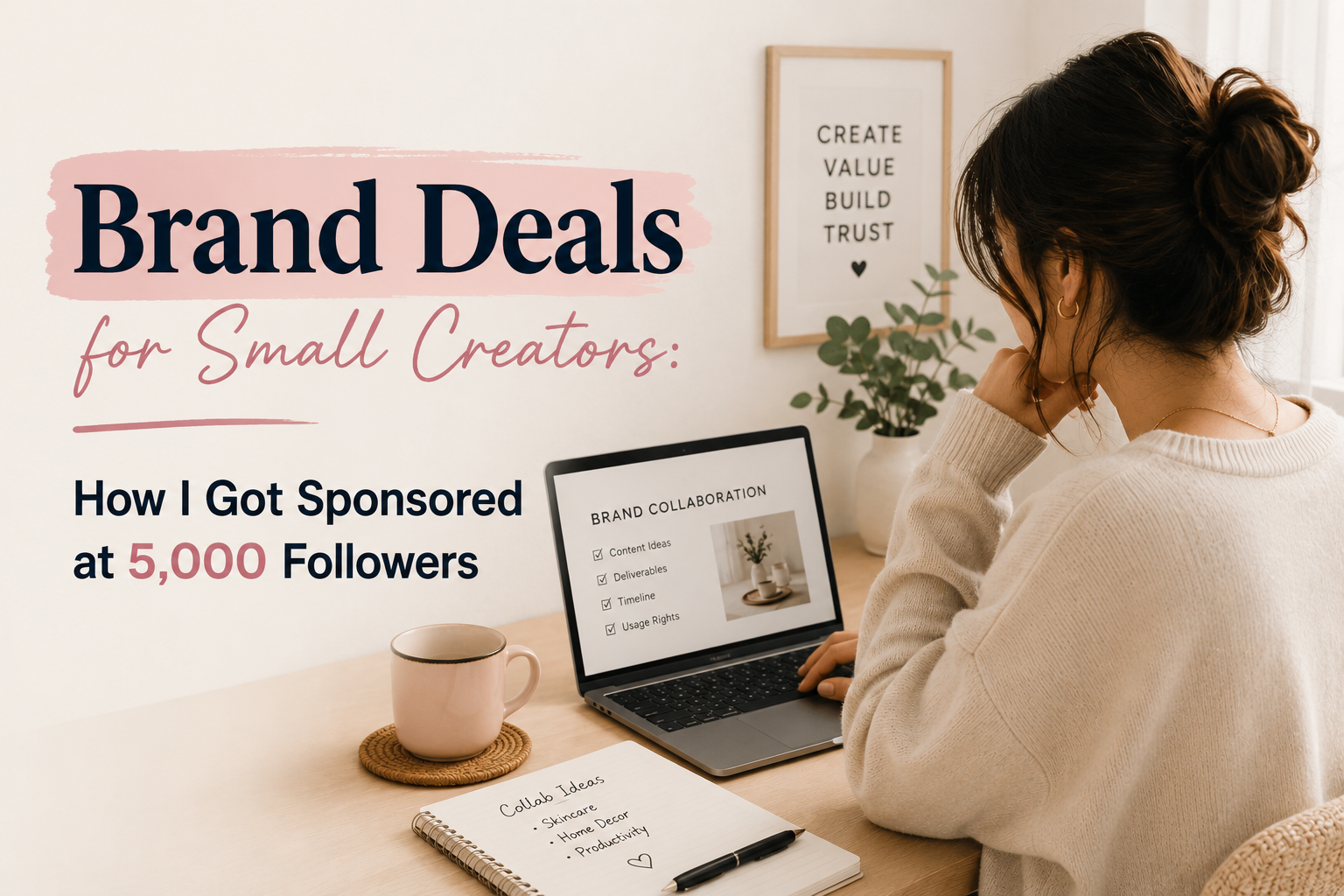
My first brand deal offer was $50 for three posts and unlimited usage rights. I almost said yes because I was excited someone wanted to work with me. Then I learned how negotiations actually work.
The Red Flags in My First Offer
Looking back, that first offer had so many problems:
- $50 for three posts is about $16 per post. Less than minimum wage.
- "Unlimited usage rights" means they can use my face and content in ads forever without paying me again.
- No content approval process mentioned.
- No timeline or deliverables clearly defined.
- Payment terms weren't specified (I later learned some brands pay Net 60, which means you wait two months).
What I Should Have Asked For
I didn't know what was standard, so I did something that felt terrifying: I asked other creators what they charged.
Here's what I learned: for a creator with 10K-25K followers in a defined niche, standard rates for an Instagram Reel start around $300-$500. For a feed post with usage rights, $150-$300.
The Counteroffer That Worked
I responded to that $50 offer with:
"Thanks for reaching out! I'm excited about [brand]. Based on my engagement rates and audience fit, my rate for one Reel is $400. This includes one round of revisions and 30-day usage rights. Would that work for your budget?"
They countered with $300. I said yes immediately.
What Should Be in Every Brand Deal Agreement
- Exact deliverables: 1 Reel, 2 stories, etc.
- Usage rights: How long can they use your content? For what channels?
- Approval process: Do you get to see the final before it goes live?
- Payment terms: When do you get paid?
- Exclusivity: Can you work with competitors during this period?
The Mindset Shift
Your content has value even at small follower counts. A brand isn't doing you a favor by offering to work with you. It's a business transaction. Act like it.
Related resources: Explore more at the Canva and CapCut.
How to Build a Media Kit That Converts
My media kit is one page. It includes: my niche description, follower count, engagement rate, average reach per post, audience demographics, and three examples of my best-performing sponsored content. That is it. No 10-page deck. No fancy animation. Just proof that I deliver results.
I update my media kit monthly. Brands want current data. A media kit from 3 months ago signals that you are not actively managing your business.
Negotiation Scripts That Work
When they lowball: "Thank you for the opportunity. Based on my engagement rate of X% and average reach of Y, my rate for this deliverable is $Z. Would a package structure work better for your budget?"
When they ghost: Send one follow-up after 5 business days. Then move on. Chasing brands makes you look desperate.
When they ask for unlimited usage: "I am happy to discuss extended usage rights. My base rate includes 30-day usage. For 6-month usage, the rate is 1.5x. For perpetual usage, the rate is 3x."
FAQ
Should I work for free to build a portfolio? Only once. Your first sponsored post can be discounted, but never free. Free work trains brands to expect free work.
How do I know what to charge? Start at $100 per 10,000 followers. Adjust up for high engagement, down for low engagement.
What if a brand says no? Most will. Rejection is normal. I have been rejected by 15 brands for every 1 that said yes.
Case Study: My First $300 Brand Deal
A software company DMd me at 5,200 followers. Offer: $50 for 3 posts with unlimited usage rights. I almost said yes out of excitement. Then I learned about negotiations.
I countered with $400 for 1 Reel and 30-day usage rights. They came back at $300. I said yes. That deal taught me more about monetization than any course.
The Negotiation Mindset
Your content has value even at small follower counts. A brand is not doing you a favor by offering $50. They are buying access to your audience. Treat it like a business transaction.
My first counteroffer script: "Thank you for reaching out. Based on my engagement rate of X% and average reach of Y, my rate for this deliverable is $Z. Would a package structure work better for your budget?"
This script positions me as a professional, not a beggar. It invites negotiation rather than demanding. It gives the brand an alternative if my rate is too high.
The Legal Framework of Brand Partnerships
Creator-brand relationships exist in a legal gray area that most beginners ignore until it becomes a problem. Understanding the basics of contract law, intellectual property rights, and disclosure requirements protects you from exploitation and legal liability.
Contract essentials: Every brand deal should have a written agreement. Verbal agreements are enforceable in some jurisdictions but difficult to prove. The contract should specify exact deliverables, usage rights, approval processes, payment terms, and termination clauses.
Intellectual property: By default, you own the content you create. However, many brand contracts include work-for-hire clauses that transfer ownership to the brand. Read every contract carefully. If a brand requests full ownership, charge accordingly. Ownership transfer should cost two to three times your standard rate.
Disclosure requirements: The Federal Trade Commission requires clear disclosure of paid partnerships. Use Instagram is built-in paid partnership tag. Include verbal disclosure in video content. State "paid partnership" or "ad" in captions. Failure to disclose can result in fines.
Negotiation Psychology and Tactics
Negotiation is not about winning. It is about finding mutually beneficial terms. Brands want value. You want fair compensation. The negotiation finds the overlap between these goals.
Tactic one: anchoring. The first number mentioned in a negotiation sets the reference point. Always let the brand make the first offer if possible. If they ask for your rate first, give a range rather than a specific number. "My rates typically fall between three hundred and seven hundred dollars depending on the scope."
Tactic two: bundling. Instead of negotiating a single post, offer a package of three posts at a slight discount. Brands love packages because they get more content. You love packages because they guarantee multiple payments.
Tactic three: the pause. After making an offer or counteroffer, stop talking. The silence creates pressure for the other party to respond. Most people fill silence with concessions. Let them.
Tactic four: alternatives. Always have a walk-away alternative before entering negotiation. If this brand says no, what will you do instead? Having alternatives prevents desperation and strengthens your negotiating position.
Building Long-Term Brand Relationships
One-time brand deals are transactional. Long-term brand partnerships are relational. I prioritize partnerships that extend beyond a single post because they provide predictable income and deeper creative collaboration.
To build long-term relationships, over-deliver on your first campaign. Submit content early. Provide analytics reports without being asked. Suggest creative ideas for future campaigns. Brands remember creators who make their jobs easier.
I currently have three ongoing brand partnerships that have lasted over six months. Each generates between one thousand and two thousand dollars monthly. These relationships are more valuable than ten one-off deals because they provide stability and allow me to plan content around consistent themes.
Legal Essentials for Creator Partnerships
Every brand deal needs a written agreement. Verbal agreements are difficult to enforce. Essential elements: exact deliverables, usage rights, approval process, payment terms, and termination clauses.
Intellectual property default: you own your content. Many brand contracts include work-for-hire clauses transferring ownership. If a brand requests full ownership, charge two to three times your standard rate.
Disclosure is legally required. Use Instagram is paid partnership tag. Include verbal disclosure in videos. State "paid partnership" in captions. FTC fines for nondisclosure are real and substantial.
Creator Brand Economics
Brands allocate 10-25% of marketing budgets to influencer partnerships. Nano influencers under 10K command $100-500 per post. Micro influencers 10K-50K command $500-2,000. Mid-tier 50K-500K command $2,000-10,000. Macro 500K+ command $10,000+. Your engagement rate and niche specificity matter more than raw follower count.
Contract Essentials
Every deal needs written agreements covering: exact deliverables, content requirements, approval process, usage rights, exclusivity terms, payment terms, and termination clauses. I charge 2-3x standard rate for unlimited usage. I charge 50% more for 3-month exclusivity and 100% more for 6-month exclusivity. For deals over $5,000, have an attorney review the contract.
Brand Partnership Red Flags
I have learned to identify five red flags that indicate a brand partnership will be problematic. Vague deliverables: "create some content about our product" without specifics. Unlimited usage rights without additional compensation. Exclusivity clauses longer than 30 days for small campaigns. Payment terms beyond net 30 without clear justification. Refusal to provide a written agreement. Any one of these red flags warrants negotiation. Two or more red flags mean I decline the partnership regardless of the offered rate.
Building a Creator Brand
Brands pay premium rates for creators who have built recognizable personal brands. My brand is built on three elements: consistent visual style using the same color palette and fonts across all content. A distinctive voice that is educational but never condescending. And a clear value proposition: practical Instagram growth advice for introverted creators. When brands approach me, they know exactly what they are buying. This clarity allows me to charge 40% more than creators with similar follower counts but undefined brands.
Scaling Brand Deal Revenue
My brand deal revenue grew from $200 to $3,000 monthly over 14 months. The growth came from three factors: improved content quality that attracted better brands, systematic outreach rather than waiting for inbound offers, and package offerings that increased average deal size. I now offer content packages rather than single posts, which increases revenue per brand relationship by 3x.
Brand Pitch Template
My cold pitch template generates a 15% response rate. Subject: Collaboration opportunity with [Your Niche] creator. Body: Hi [Name], I have been following [Brand] for [Time Period] and love [Specific Product/Value]. I create content about [Your Niche] and my audience of [Follower Count] highly engaged [Audience Description] would benefit from learning about [Brand]. Would you be open to exploring a paid partnership? I have attached my media kit for your review. Best regards, [Your Name]. Short, specific, and professional.
Follow-Up Strategy
If a brand does not respond within 7 days, I send one polite follow-up. If they still do not respond, I move on. Chasing brands signals desperation. Professional creators have options and act accordingly. My follow-up rate is exactly 50% of initial pitches. The brands that respond to follow-ups often convert at higher rates because the additional touchpoint demonstrates genuine interest.
Maya Chen
Creator, writer, and recovering perfectionist. I share what I learn growing Instagram accounts and building a creator business — the honest way.