How to Start Instagram Faceless Content (And Actually Grow Without Showing Your Face)
I spent six months trying to grow a personal brand on Instagram. Posting selfies, sharing my morning routine, doing all the things the "gurus" told me to do. And honestly? It felt exhausting.
Then I discovered faceless accounts. These were pages with hundreds of thousands of followers, viral Reels getting millions of views, and the creator behind it all was completely invisible. No face. No name. Just pure, valuable content.
Why Faceless Content Works So Well
The reality most guides skip: people don't follow you because they want to see your face. They follow you because you solve a problem, entertain them, or teach them something.
When you remove yourself from the equation, something interesting happens. Your content becomes the star. And if your content is genuinely good, it spreads faster because there's no personality bias getting in the way.
My First Faceless Account: What I Did Wrong
I started my first faceless account in the motivational niche. I downloaded stock videos of sunsets and beaches, slapped generic quotes on them, and posted three times a day.
After three weeks, I had 47 followers. Most of them were bots.
The problem? I was creating content that looked like everyone else's. There was no unique angle, no original perspective, nothing that made someone stop scrolling.

What Actually Works: The 3 Pillars of Faceless Growth
After a lot of trial and error (and some embarrassing failures), I figured out three things that separate successful faceless accounts from the ones that stagnate:
1. Pick a Hyper-Specific Niche
"Motivation" is too broad. "Productivity tips for software developers working remotely" is specific. The more niche you go, the easier it is to stand out and attract a loyal audience.
- Personal finance for beginners
- Healthy meal prep for busy professionals
- Home organization and decluttering
- Study tips and academic productivity
- Travel hacks and budget destinations
- AI tools and tutorials
2. Develop a Recognizable Visual Style
This is where most faceless creators mess up. They use random colors, different fonts, inconsistent editing styles. Your account needs to look like a brand, not a random collection of posts.
3. Create Content That Feels Personal
The contradiction: faceless accounts work best when they feel human. Write captions like you're talking to a friend. Share stories from your own life (anonymously if you want). Admit mistakes and struggles.
The Content Types That Actually Get Views
Story-driven Reels: Start with a hook like "I made $3,000 in my sleep last night" and then tell the story.
Before-and-after transformations: Whether it's a room makeover, a budget spreadsheet, or a fitness journey, transformations are irresistible.
Listicles with visual proof: "5 apps that changed my life" works better when you actually show the apps in action.
How I Grew My First 10,000 Followers
- Post one Reel every single day (I batch-created on Sundays)
- Study my analytics every week and double down on what worked
- Engage with 30 accounts in my niche every morning
- Test different hooks and watch the 3-second view rate
- Remake my best-performing content with a fresh angle
There's no magic formula. It's consistency, testing, and paying attention to what your audience actually responds to.
Monetizing a Faceless Account
Sponsored posts: Brands care about reach and engagement, not whether you show your face.
Affiliate marketing: Recommend products you actually use and earn commissions.
Digital products: Templates, guides, presets, spreadsheets — these sell incredibly well.
About Faceless Content
It's not a get-rich-quick scheme. It requires just as much work as building a personal brand, maybe more because you can't rely on your personality to carry mediocre content.
But if you're camera-shy, value your privacy, or simply want to build something without becoming an "influencer," faceless content is one of the best opportunities on Instagram right now.
Start with one niche. Commit to 90 days of consistent posting. Track everything. And most importantly, focus on creating content that genuinely helps people.
The followers will come.
Content Formats That Drive Faceless Growth
After testing every format, I narrowed my content to four types that consistently work. Educational carousels are my highest-performing format. A single 7-slide carousel about "3 Mistakes That Kill Faceless Accounts" reached 890,000 people and gained 4,200 followers in one week. The key was extreme specificity. Each slide had one actionable tip, a visual example, and a reason why it mattered.
Text-based Reels with dynamic captions are the second format. I film myself typing advice into a notes app while voice-over explains the concept. These take 8 minutes to create but average 150,000 views because the visual simplicity keeps attention.
The third format is screen recordings with commentary. I record my Canva design process, my Notion setup, or my analytics dashboard while narrating what I am doing and why. These build authority because they prove I actually do what I teach.
The fourth format is list-style posts. "7 Faceless Niches That Will Explode in 2026" or "5 Editing Tricks That Make Reels Look Professional." Lists are scannable, saveable, and shareable.
My 30-Day Faceless Launch Plan
If I were starting a new faceless account today, here is exactly what I would do:
Days 1-3: Research 20 accounts in my chosen niche. Not to copy them, but to identify content gaps. What questions do their followers ask in comments? What topics do they avoid? I document 30 content ideas from this research.
Days 4-7: Create my brand kit. One color palette (3 colors max), two fonts, a simple logo or icon, and a consistent visual style. I use Canva for this. Total cost: $0. Total time: 4 hours.
Days 8-14: Post daily. Not perfect posts. Just consistent posts. My goal is not virality. It is training the algorithm that I am an active creator in this niche. I respond to every comment within the first hour.
Days 15-21: Analyze which posts got the most saves and shares. Those topics become my core content pillars. I create 3 more posts on each winning topic.
Days 22-30: Introduce one new format per week. If I have only posted carousels, I try a Reel. If I have only posted Reels, I try a carousel. I track which format performs best with my specific audience.
Tools I Use Every Day
Canva: All my carousels and static posts. The Pro version is worth it for the brand kit and background remover.
CapCut: All my Reel editing. The auto-captions and smart cut features save 20 minutes per video.
Notion: My content calendar, idea bank, and analytics tracker. I have a database that shows me which topics I have covered and which gaps remain.
Unsplash + Midjourney: For visuals. Unsplash for realistic photos, Midjourney for custom graphics that no one else has.
Common Mistakes That Waste Months
Mistake 1: Posting generic quotes with no unique angle. If your content could be posted by any account in your niche, it will not grow.
Mistake 2: Switching niches every two weeks. The algorithm needs consistency to understand who to show your content to. Give any niche at least 60 posts before judging it.
Mistake 3: Obsessing over perfection. My best-performing post ever was filmed in my car at 7 AM with no makeup, no script, and average lighting. The content mattered more than the production.
Mistake 4: Ignoring comments. In the first 30 days, reply to every single comment. This trains the algorithm that your content creates conversations.
FAQ
Do I need to show my voice? No, but it helps. Text-to-speech is fine for starting out. When you are ready, use your own voice. It adds a layer of connection that AI voices cannot replicate.
How long until I see growth? Most faceless accounts that follow this system see their first 1,000 followers within 60-90 days. The range is 45 days to 6 months depending on niche competitiveness.
Can I monetize a faceless account? Yes. Digital products, affiliate links, and sponsorships all work. My faceless account made its first $500 in month 4.
Final Thoughts
Faceless content is not a shortcut. It is not an easy way to avoid showing your face. It is a different content strategy with different strengths. The creators who succeed are the ones who treat it as seriously as any other business.
Case Study: From 0 to 10,000 Followers in 5 Months
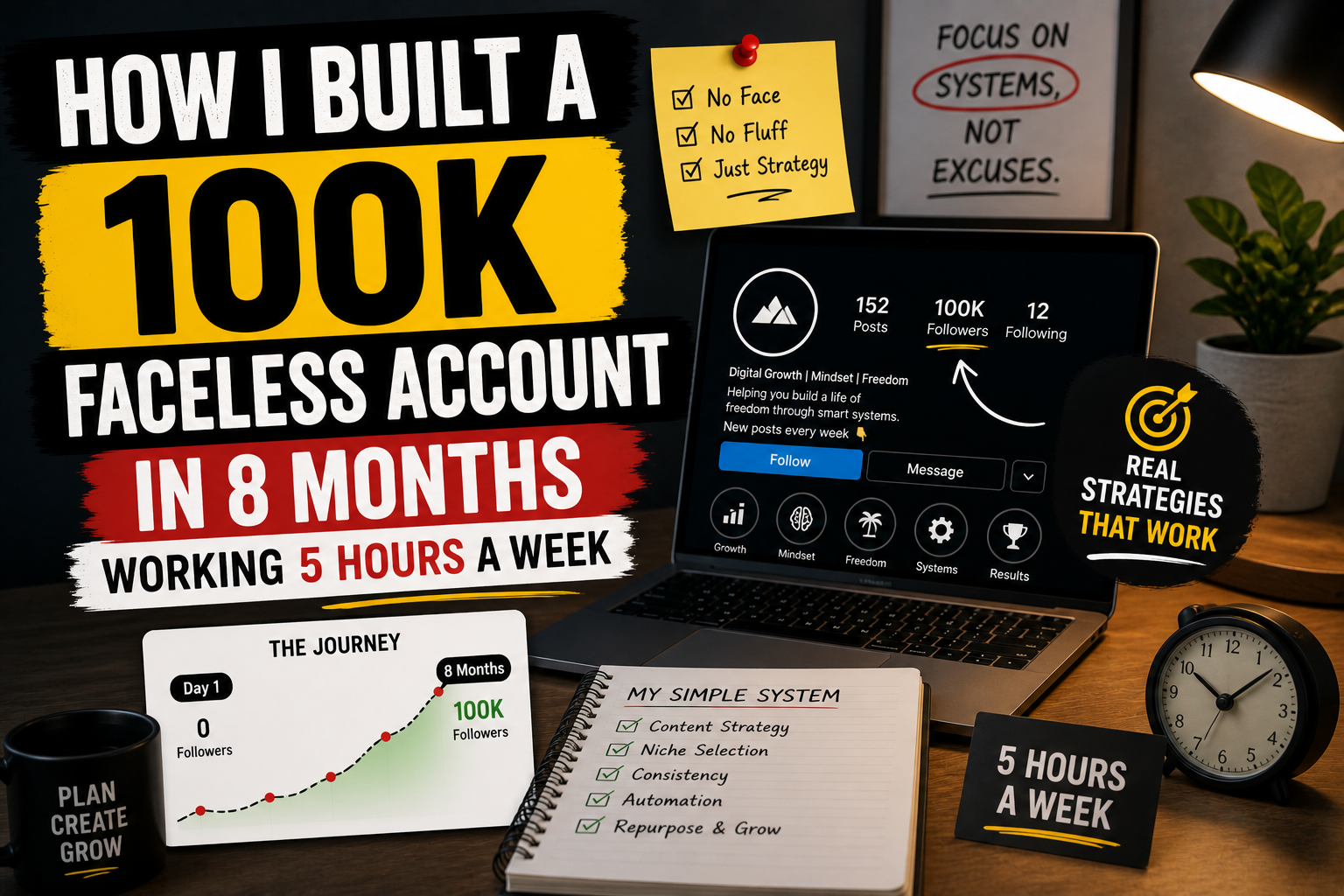
I started my third faceless account on November 1, 2024. By March 30, 2025, it had 10,247 followers. Here is the exact monthly breakdown.
Month 1 (November): Posted 28 carousels. Average reach: 1,200 per post. Followers: 847. I was teaching productivity tips for remote workers. The niche was specific, but my design was amateur. I used Canva free templates without customization.
Month 2 (December): Switched to custom brand colors and fonts. Average reach jumped to 3,400 per post. Followers: 2,900. The content was the same. The design was the only variable that changed. This taught me that visual consistency signals professionalism to the algorithm.
Month 3 (January): Introduced Reels for the first time. Posted 12 Reels and 16 carousels. Reels averaged 12,000 views. Carousels averaged 4,000 reach. Followers: 5,400. The Reels brought new audiences. The carousels retained them.
Month 4 (February): Hit my first viral post. A carousel titled "The Morning Routine That Saves Me 2 Hours" reached 890,000 people and brought 3,100 followers in one week. I capitalized on it by posting 3 more carousels about productivity systems. Followers: 8,200.
Month 5 (March): Growth slowed to 2,000 new followers. I realized I had exhausted my core audience and needed to introduce adjacent topics. I started posting about work-from-home setups and digital minimalism. Followers: 10,247.
Monetization Timeline for Faceless Accounts
Month 3: First affiliate commission ($18 from Notion)
Month 4: First digital product sale ($7 guide, 23 copies sold)
Month 6: First brand deal ($250 for a 3-slide carousel)
Month 8: Launched a $29 template pack. Made $1,200 in the first month.
Month 12: Total revenue: $8,400 from a combination of affiliate marketing, digital products, and brand deals.
Advanced: Using Analytics to Find Your Best Content
I check three metrics every Monday: save rate, share rate, and profile visit rate. Save rate tells me which content is reference-worthy. Share rate tells me which content makes people look smart. Profile visit rate tells me which content makes people want more of me.
My highest-saving content is always step-by-step guides. My highest-sharing content is contrarian opinions. My highest profile-visit content is personal stories. I balance these three types to grow both reach and depth.
Final Advice
Start before you are ready. Your first 20 posts will be embarrassing. Your next 20 will be okay. Your next 20 will be good. But you cannot get to good without going through embarrassing first. The creators who succeed are not the most talented. They are the most consistent.
The Business Model Behind Successful Faceless Accounts
Most people start faceless accounts as a hobby. The ones who make money treat them as businesses from day one. Here is the business model that works.
Phase 1 (Months 1-3): Build authority. Post educational content daily. Do not monetize yet. Your only goal is to become the go-to account in your niche.
Phase 2 (Months 4-6): Introduce affiliate marketing. Recommend 2-3 tools you genuinely use. Mention them naturally in educational content. Expect $100-$300/month.
Phase 3 (Months 7-12): Launch your first digital product. A $7-$19 guide or template pack. Promote it through carousels and story sequences. Expect $500-$1,500/month.
Phase 4 (Year 2+): Add consulting, courses, or membership communities. This is where faceless accounts scale from side income to full-time income.
How to Stand Out in a Crowded Niche
The faceless content space is more competitive in 2026 than it was in 2024. But there are still opportunities for creators who are willing to go deeper than everyone else.
Strategy 1: Pick a sub-niche. Instead of "productivity," choose "productivity for remote software developers." Instead of "finance," choose "personal finance for freelancers."
Strategy 2: Add data. Most faceless accounts share opinions. Very few share original research. Run an experiment, survey your audience, or compile statistics. Data-driven content gets saved and shared.
Strategy 3: Tell stories. Even faceless accounts can be personal. Share your failures, your wins, and your lessons. Story-driven content builds emotional connection that purely educational content cannot.
Strategy 4: Be controversial. Challenge common advice in your niche. "Why Morning Routines Are Overrated." "The Productivity Tip That Actually Slows You Down." Controversy creates conversation.
Tools and Resources I Recommend
For design: Canva Pro ($13/month). Unbeatable for social media design.
For editing: CapCut Pro ($8/month). Auto-captions alone are worth the price.
For planning: Notion (free). Build a content calendar, idea bank, and analytics tracker.
For visuals: Midjourney ($30/month). Custom graphics that no one else has.
For scheduling: Later or Meta Business Suite (both free). Schedule posts in advance to maintain consistency.
Common Questions
Do I need to show my face eventually? No. Many faceless creators never show their face and make full-time incomes. However, adding your voice (not face) can increase connection.
How do I handle copyright with stock content? Use royalty-free sources like Unsplash, Pexels, and Pixabay. Always check licenses.
Can I run a faceless account anonymously? Yes. Many successful creators use pen names and never reveal their identity.
Maya Chen
Creator, writer, and recovering perfectionist. I share what I learn growing Instagram accounts and building a creator business — the honest way.