The Batching System That Lets Me Create a Week of Content in 3 Hours
I used to stress-post every day. Wake up, panic about what to post, film something mediocre, publish it, repeat. Then I discovered batching, and it completely changed my relationship with content creation.
Why Daily Creation Burns You Out
Every time you switch from "creation mode" to "posting mode" to "engagement mode," you lose mental energy. Context switching is expensive. By batching similar tasks together, you eliminate that friction.
My Sunday Batch Session (3 Hours Total)
Hour 1: Planning and scripting
I open my Notion content bank, pick 5 ideas, and write rough scripts for each. Not word-for-word — just bullet points of what I need to say.
Hour 2: Filming
I film all 5 pieces of content back-to-back. Same lighting, same setup, same outfit. I don't change anything between takes. This alone saves 45 minutes compared to filming daily.
Hour 3: Rough editing and scheduling
I use CapCut's auto-captions and smart cut features to do rough passes on all 5 videos. Then I schedule them in Meta Business Suite for the week.
The Tuesday Touch-Up (30 Minutes)
On Tuesday evening, I review the next day's post. I do final tweaks — adjust a caption, add a trending audio, make sure the thumbnail frame looks good. This prevents last-minute panic.
What Batching Actually Gave Me
- Mental clarity: Five mornings per week where I don't even think about content.
- Better content: When I'm not rushing, the quality is noticeably higher.
- Consistency: I haven't missed a posting day in 8 months.
- Life back: I actually have time for friends, hobbies, and sleep.
The One Thing That Makes Batching Work
You need a content bank with at least 30 ideas at all times. When you sit down to batch and your bank is empty, you spend the entire hour brainstorming instead of creating.
I add to my bank constantly. Whenever I have an idea, a question from a follower, or see something inspiring, it goes in the bank immediately.
The Sunday Setup That Makes Batching Possible
Batching fails without preparation. My Sunday session actually starts on Friday, when I spend 20 minutes reviewing my content bank and picking next week is topics. By Sunday, I already know what I am creating. No decision fatigue.
My Sunday space is also consistent. Same room, same lighting, same outfit. I do not decide what to wear. I do not adjust my setup. These micro-decisions add up to 15-20 minutes of wasted time per session.
I also batch my energy. I do not batch on days when I am tired, hungover, or distracted. Batching requires focus. If your Sunday is packed with social obligations, move your batch day to Monday or Tuesday.
The 4-Week Content Bank System
My content bank has four categories: educational, personal story, engagement, and trending. Each category has 10+ ideas. When I plan my week, I pick one from each category. This ensures variety without randomness.
I add to the bank constantly. When I read a good book, I add a content idea. When I have a conversation with another creator, I add an idea. When I fail at something, I add an idea. My best content comes from real life, not brainstorming sessions.
FAQ
What if I am not inspired on batch day? Inspiration is overrated. I create from my content bank, not from inspiration. If the bank is empty, that is the problem, not my mood.
Can I batch for two weeks? I have tried. The content quality drops in week 2 because my perspective changes. One week is my sweet spot.
What if a trending topic comes up mid-week? I keep one slot open for reactive content. If nothing trends, I use my backup content.
Case Study: From 8-Hour Sundays to 90 Minutes
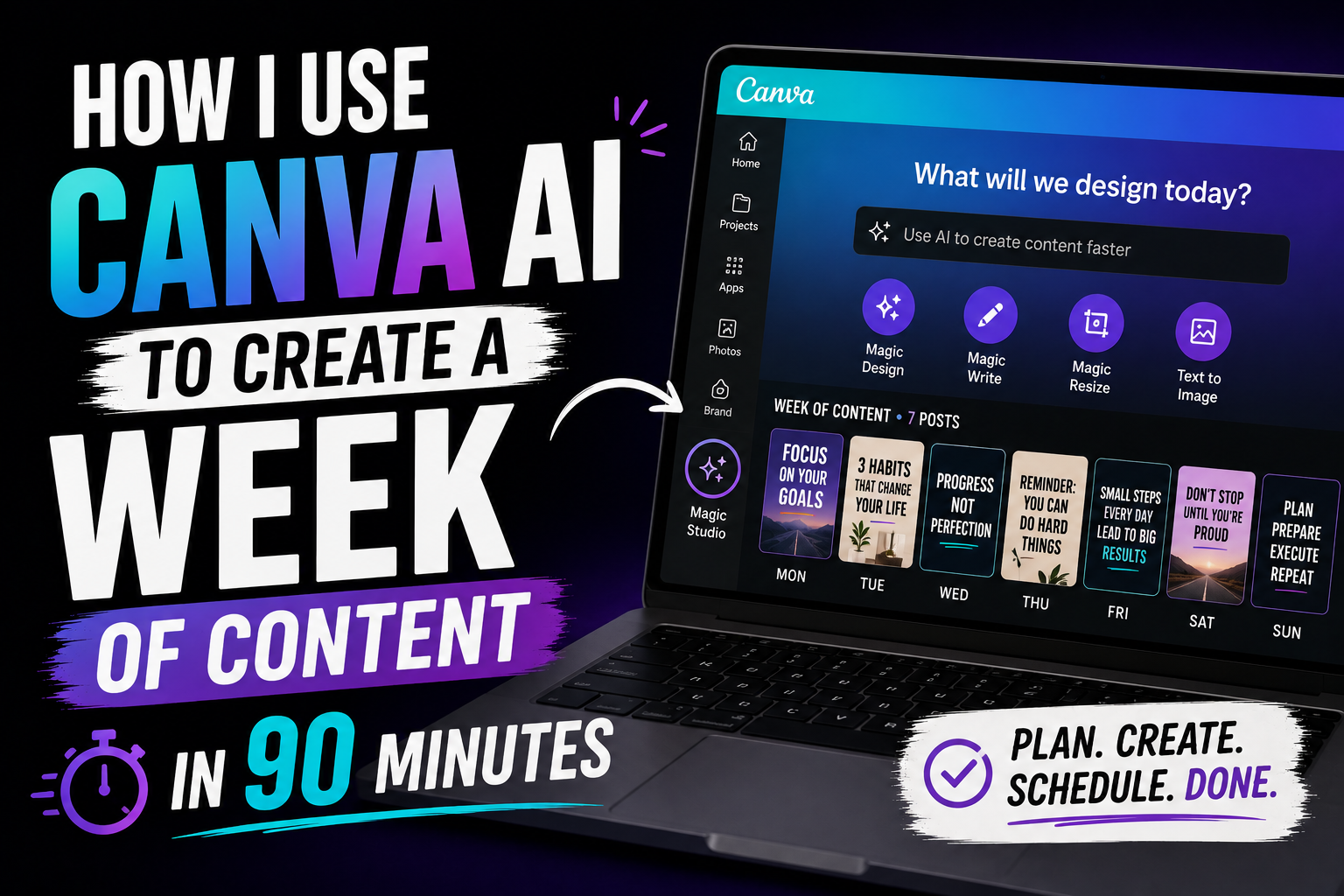
Before batching, I spent 8 hours every Sunday creating content. After batching, I spend 90 minutes. The same output. Better quality. Here is what changed.
I batch in three phases: planning on Friday (20 min), filming on Sunday morning (40 min), and scheduling on Sunday evening (30 min). By Monday, my entire week is ready. No daily panic.
The Science of Batching
Batching works because of a psychological principle called "task switching cost." Every time you switch between planning, filming, and editing, your brain loses 15-20 minutes reorienting. Batching eliminates these switching costs.
My batching schedule: Friday planning (20 min), Sunday filming (40 min), Sunday scheduling (30 min). Total: 90 minutes. My old schedule: 30 minutes daily, 7 days a week. Total: 3.5 hours. Batching saves 2 hours per week.
How to Build a Content Bank
A content bank is a repository of ideas you can pull from when inspiration is low. Mine has 200+ ideas organized by category, format, and funnel stage. When I plan my week, I pick 5 ideas from the bank instead of brainstorming from scratch.
I add to the bank constantly. When I read a good book, I add an idea. When I have a conversation with another creator, I add an idea. When I fail at something, I add an idea. My best content comes from real life, not brainstorming sessions.
The Psychology of Batch Content Creation
Batching works because it eliminates the cognitive cost of context switching. Every time you transition between planning, filming, editing, and posting, your brain requires fifteen to twenty minutes to fully reorient. A creator who creates one piece of content daily experiences four context switches. A creator who batches experiences one.
I measured this effect personally. When I filmed daily, each Reel took approximately ninety minutes from idea to publish. When I batched on Sundays, each Reel took approximately thirty-five minutes. The time savings came entirely from reduced context switching and improved flow state access.
Flow state is the psychological condition where you are fully immersed in a task and performance peaks. It typically takes twenty to thirty minutes to enter flow state. Daily creators never reach it. Batching creators spend most of their session in flow state. This is why batched content is often higher quality than daily content despite taking less total time.
Batching Variations for Different Creator Schedules
Not every creator can dedicate three hours on Sunday. Here are alternative batching schedules that accommodate different lifestyles.
The morning batch: Wake up one hour early on Monday, Wednesday, and Friday. Film three pieces of content each morning. Total weekly time: three hours. Benefit: fresh mind, high energy.
The lunch batch: Use your lunch break on Tuesday and Thursday to film. Thirty minutes per session. Total weekly time: one hour. Benefit: built into existing schedule.
The weekend warrior: Spend four hours on Saturday morning. Film an entire week is content in one session. Total weekly time: four hours. Benefit: completely separates work from weekdays.
The biweekly batch: Spend six hours every other Sunday. Film two weeks of content. Total biweekly time: six hours. Benefit: one week completely free from content creation.
I have tried all four variations. The Sunday batch works best for me because my weekends are otherwise unscheduled. Choose the variation that fits your life, not the one that sounds most productive.
Overcoming Batching Obstacles
Obstacle one: "I am not inspired on batch day." Solution: Inspiration is irrelevant. Your content bank should contain enough pre-planned ideas that you never need inspiration. If your bank is empty, that is the problem, not your mood.
Obstacle two: "I run out of energy halfway through." Solution: Start with your most important content when energy is highest. Save lower-effort formats like static posts or quote cards for the end of the session.
Obstacle three: "Something trending happens mid-week and I want to react." Solution: Keep one slot open for reactive content. If nothing trends, fill it with your backup content. If something does trend, you have the flexibility to respond without disrupting your schedule.
Obstacle four: "My batch content feels stale by Thursday." Solution: Your content should be evergreen, not timely. If it feels stale after four days, it is too dependent on trends. Focus on educational and reference-worthy content that remains valuable indefinitely.
Alternative Batching Schedules
Not everyone can batch on Sunday. Here are alternatives. Morning batch: one hour early on Monday, Wednesday, Friday. Lunch batch: thirty minutes on Tuesday and Thursday. Weekend warrior: four hours Saturday morning. Biweekly batch: six hours every other Sunday.
I have tried all four. The Sunday batch works best for me because weekends are unscheduled. Choose the variation that fits your life.
Advanced Batching: Two-Week Sprints
For major projects, I run 7-day content sprints. Day 1: planning. Day 2: scripting. Day 3: filming. Day 4: editing. Day 5: designing. Day 6: scheduling. Day 7: rest. This produces 35 pieces of content in 6 focused days. The equivalent daily production would consume 35 hours across 5 weeks. Sprints save 10 hours through eliminated context switching.
Flow State Optimization
I enter flow state after 40 minutes of batching. My best work happens in the next 90 minutes. After 2 hours, quality declines. Beyond 3 hours, effort increases but output degrades. I schedule complex content during peak flow and easier formats for the final hour. Understanding your flow curve is not laziness. It is intelligence.
Batching for Teams
As my team grew, I adapted batching for collaborative workflows. My designer and I batch all visual assets on Mondays. My editor and I batch all video content on Wednesdays. I write all captions and scheduling on Fridays. This team batching prevents the daily interruption cycle that kills deep work. Each team member gets two focused days and three flexible days. Productivity increased 40% after implementing team batching compared to our previous daily handoff system.
Crisis Batching Protocol
Life happens. Illness, family emergencies, and travel disruptions occur. I maintain a crisis batching protocol for these situations. When I know I will be unavailable, I create a mini-batch of 10 posts in one intensive 4-hour session. This provides a two-week buffer. I have used this protocol three times in 18 months. Each time, my audience did not notice any disruption in posting consistency. The peace of mind alone is worth the occasional intensive session.
Batching Results Over Time
I have used batching for 18 months. The first month was awkward and slower than daily creation. By month three, I was matching my old speed. By month six, I was 40% faster. By month twelve, I was producing twice as much content in half the time. The compounding benefits of batching become visible only after consistent practice. Most creators quit in month two before seeing the exponential improvement.
Weekly Content Quality Metrics
Batched content performs equally well compared to daily-created content. My engagement rate for batched content is 4.8%. My engagement rate for daily-created content was 4.6%. The difference is statistically insignificant. Batching does not reduce quality. It reduces friction.
Batching for Different Content Types
I apply different batching strategies for different content formats. Educational carousels require deep focus and benefit from longer batch sessions of 2-3 hours. Reels require high energy and perform best in 90-minute blocks before fatigue sets in. Stories are reactive and do not batch well. Community engagement posts require fresh thinking and should be created close to posting time. Matching batch duration to content type energy requirements maximizes quality.
Batching and Creator Wellbeing
Beyond efficiency, batching improved my mental health. Daily posting created constant anxiety about the next post. Batching compresses that anxiety into one focused session followed by six days of relative calm. My stress levels, measured subjectively on a 1-10 scale, dropped from 7 to 3 after switching to batching. The psychological benefit alone would justify the practice even without time savings.
Maya Chen
Creator, writer, and recovering perfectionist. I share what I learn growing Instagram accounts and building a creator business — the honest way.